 Gluten-Free Bakery
Gluten-Free Bakery (Piekarnia Bez Glutenu)
A bakery's wholesale sales in one panel — instead of 17 channels of chaos. Stores order on their own, the baker prints a ready production run.
b2b.bezglutenupiekarnia.pl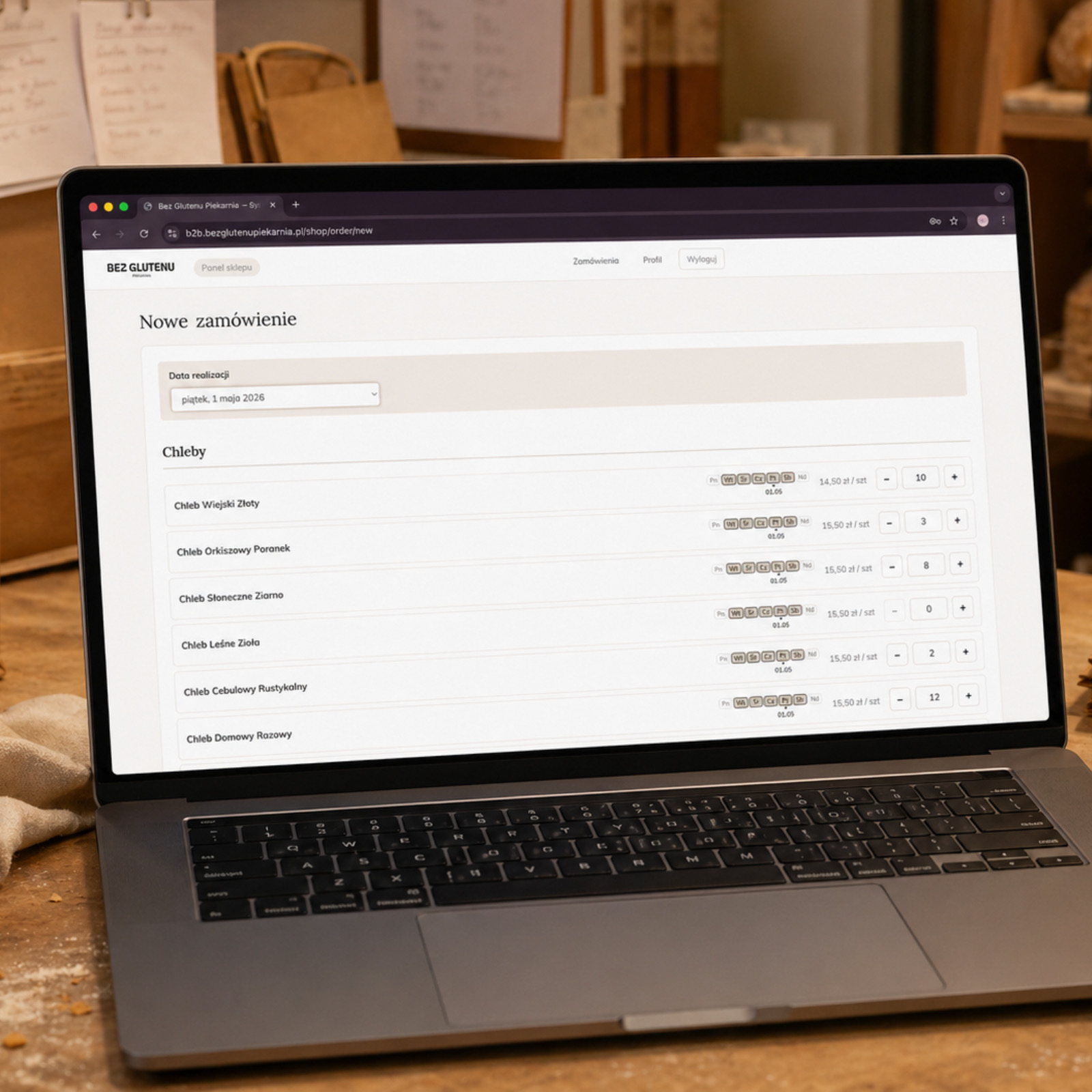
Project overview
Who it's for:
- Bakeries and patisseries with a network of retail buyers
- Food producers selling wholesale to delis and chains
- Artisan manufacturers with a repeatable weekly production cycle
The problem
"Every morning I reply to text messages, listen to voice notes and manually retype orders from fifteen stores. The first two hours of the day go to transcribing, not baking."
So instead of yet another complicated ERP platform, we built a dedicated system where wholesale stores place orders through a simple panel and the baker gets ready-to-use production printouts — with exact quantities for each baking day, split by category and role.
Key results for the bakery
With the new system the baker gets the morning back, and stores order in 30 seconds.
One panel instead of 17 channels
All orders from 15 wholesale stores in a single view — no more texts, phone calls and Messenger.
Production calendar built into the price list
The system tracks what gets baked when. A store can't order bread on a day when the baker only makes rolls.
Production prints itself
Two printouts in one click — a product × store matrix and separate packing sheets.
Challenges
Orders pour in through 17 channels at once
Text messages, photos of menus, phone calls, emails, Messenger, paper slips tucked into bread bags. No single place with a history. It's easy to lose something, mix up a quantity or forget about the new store that joined last week.
Manual retyping costs 2 hours a day
Every morning the baker or a family member retypes orders from chats into a notebook or Excel to know how much of what to bake. One transcription mistake = missing bread for a store, or overproduction in the oven.
Every store is billed differently
Different wholesale discounts, different delivery days, two VAT rates (5% for breads, 8% for selected sweets), custom prices for selected clients. Without a system, all of it has to be remembered and calculated by hand — or the accountant has to correct the invoice.
The baker and the pastry chef work from different lists
The baker bakes breads from 4:00 AM, the pastry chef makes sweets from 6:00 AM. Each needs a different part of the same order — but until now they got one jumbled list and had to pick out their own items.
Our approach
The project was built around a single idea:
"A store should order in 30 seconds, the baker should get the production run in 1 click."
From day one we focused on two perspectives: the daily routine of the wholesale store and the baker's morning routine in the back room.
The solution: inside the Gluten-Free Bakery system
Four key elements that changed the bakery's morning and the way wholesale stores place orders.
An ordering panel for every store
Each wholesale buyer logs into their own panel and immediately sees: the next delivery day, the time left until the ordering cutoff (deadline at 11:59), and their previous order ready to copy with one click. When placing a new order, the system shows only the products available on the chosen baking day — with the current net and gross price and the assigned wholesale discount.
A store places a new order faster than it could type a text message — with full history, an automatic discount and an email confirmation.
A production calendar built into the catalog
Every product has assigned baking days (e.g. rye bread — Tuesday, Thursday, Friday) and a production role (baker or pastry chef). The system won't show a store any product that can't be baked for the chosen delivery date. Holidays, days off and seasonal breaks are added with a single click in the "Closures" section — and automatically disappear from the available dates in every store.
Zero orders that can't be fulfilled. Zero explaining to customers that "there's no rye bread today".
Two production printouts in one click
From the admin panel, the baker picks a delivery date and downloads the full printout set. First: a "product × store" matrix grouped by category (Breads, Rolls, Savory Bakes, Sweet Bakes) — for planning quantities at the oven and the workbench. Second: separate sheets for every store with notes, totals and the discount — for packing orders and issuing documents.
The pastry chef checks their items (Sweet Bakes) on a phone, the baker prints the matrix on A4. Everyone sees only what concerns them.
Automation you don't see
Prices and VAT rates are locked in at the moment an order is placed — a price-list change never breaks history or affects last week's invoice. Per-store discounts are applied automatically, with no manual math. A daily cron reminds stores about their default ordering day, so orders flow in regularly — without manually typing "remember tomorrow's delivery?".
Fewer emails in the baker's inbox. More repeatable, on-time orders from partner stores.
"The first two hours of the day, reclaimed. Instead of retyping text messages into Excel, I open the panel, print the production run and go bake."
Gluten-Free Bakery
Wholesale supply for 15 partner stores in Poland
Let's talk about your project
Tell us about your needs and challenges – we'll show you how we can help and how much time you could save.
hello@spectrumflr.com